
The Heart of the Feedlot: PTO Shafts for TMR Mixers
Feeding the Herd in Castro and Goiás. High-Torque, Wide-Angle Drivelines for Vertical and Horizontal Diet Feeders in Brazilian Intensive Livestock Farming.
Field Notes: The “Morning Start” Challenge
In the intensive dairy clusters of Castro (Paraná) and the massive beef feedlots (confinamentos) of Goiás, the TMR Mixer Wagon (Vagão Misturador de Ração Total) is the most critical machine on the farm. It operates 365 days a year, rain or shine. Whether it is a vertical auger mixer (misturador vertical) cutting round bales or a horizontal paddle mixer blending wet byproducts, the load profile is brutal.
The most dangerous moment for the drivetrain is the Loaded Startup. Often, a mixer is loaded the night before or stopped mid-cycle. Starting a 15-cubic-meter wagon filled with 8 tons of wet silage and grain creates a torque spike that can snap standard PTO shafts instantly.
Additionally, feed alleys (pistas de trato) in Brazil are often narrow. To distribute feed into the troughs, the tractor must turn sharply while the mixer is running at full power.
The Problem: Standard U-joint shafts cannot handle angles over 25 degrees without “chatter” (velocity fluctuation). This vibration destroys the tractor’s PTO stub and the mixer’s planetary gearbox seals.

The EVER-POWER Solution: We mandate the use of the Series 8 Constant Velocity (CV) Driveline. This shaft allows for 80-degree turns without vibration, essential for maneuvering in tight feedlots. We also integrate a High-Capacity Friction Clutch. Unlike a shear bolt that breaks and causes downtime, the friction clutch slips momentarily to absorb the “dead start” shock load, protecting the expensive planetary gearbox of the mixer.
Technical Specifications & Engineering Parameters
TMR Mixers require the highest torque rating in the agricultural sector, often exceeding tillage equipment. Below are the specs for our Livestock Series.
| Parameter ID | Specification Category | Technical Value / Standard |
|---|---|---|
| 01 | Series Classification | Series 8 (Standard) / Series 10 (Mega-Mixers) |
| 02 | Nominal Torque (540 RPM) | 1,240 Nm (S8) / 1,850 Nm (S10) |
| 03 | Nominal Torque (1000 RPM) | 980 Nm (S8) / 1,450 Nm (S10) |
| 04 | Max Shock Load Rating | 5,000 Nm (Startup Spike) |
| 05 | Tractor Interface | 1-3/8″ Z6, 1-3/8″ Z21, or 1-3/4″ Z20 (CV Joint) |
| 06 | Implement Interface | 1-3/4″ Z6 or 1-3/4″ Z20 (Gearbox Input) |
| 07 | Closed Length (Lz) | 1,210 mm – 1,610 mm (Long Reach for Hitch) |
| 08 | Tube Profile | Star Profile (S5/S6) – Multi-Point Contact |
| 09 | Tube Material | ST52 Cold Drawn Precision Steel |
| 10 | Cross Kit Dimensions | 35mm x 106.5mm (S8) / 42mm x 104mm (S10) |
| 11 | Bearing Type | High-Performance Sealed Needle Roller |
| 12 | Safety Device | Friction Clutch (FV) or Cam Clutch (K64) |
| 13 | Torque Setting | 1,800 Nm – 3,500 Nm (Calibrated to Gearbox) |
| 14 | Operating Angle | Max 80° (Constant Velocity – Essential) |
| 15 | Wide Angle (CV) | Standard on Tractor Side (80 deg) |
| 16 | Guard Material | UV Stabilized HDPE (Yellow/Black) |
| 17 | Guard Certification | NR-12 / ISO 5674 |
| 18 | Lubricación | Moly-Fortified High-Load Grease |
| 19 | Tratamiento de superficies | Zinc-Nickel Plating (Silage Acid Resistance) |
| 20 | Telescoping Overlap | Min 400mm (Required for sharp turns) |
| 21 | Clutch Reset | Automatic (Slipping Friction) |
| 22 | Peso | 45 kg – 75 kg |
| 23 | Aplicación | Vertical Mixer / Horizontal Mixer / Manure Spreader |
| 24 | Warranty | 1 Year (Structure) / 1000 Hours |
| 25 | Origin Compatibility | Casale, Kuhn, Ipacol, DeLaval, Nogueira |
The Physics of the Mix: Viscosity and Geometry
Mixing feed involves moving heavy, wet, fibrous material. The physics dictate the shaft requirements.
1. The “Volcano” Effect (Misturadores Verticais)
Vertical mixers use a large tapered auger to lift feed from the bottom and drop it at the top.
The Load: To lift 10 tons of feed, the auger needs massive torque. When cutting a round bale of hay, the resistance spikes as the knives engage the dense bale core.
The Solution: High-Torque Friction Clutches. We use 4-plate friction clutches with ventilated housings. These allow the shaft to slip momentarily when a bale resists cutting, preventing the tractor engine from stalling or the shaft from twisting.

2. The Feed Alley Turn (A Curva no Barracão)
To deliver feed, the tractor drives down narrow alleys. At the end, it must turn 90 degrees to exit or switch alleys. The mixer is often still running to clear the discharge chute.
The Geometry: Turning at 540 RPM creates “cardan error” (speed fluctuation) in standard joints. This shakes the mixer wagon violently.
The Solution: El Wide-Angle CV Joint. By using a double-cardan centering mechanism, the CV joint maintains constant output speed regardless of the angle. This protects the mixer’s weigh-bars (load cells) from vibration damage, ensuring accurate ration weights.

3. Corrosion from Silage (Ácido Lático)
Silage juice is acidic. It sprays onto the PTO shaft during loading and mixing.
The Wear: Acid causes rapid rusting of the telescoping tubes. If the tubes rust together, the shaft cannot telescope during a turn, resulting in a bent shaft or broken gearbox input.
The Defense: Zinc-Nickel Plating. We do not rely on paint. We plate the inner and outer tubes with Zinc-Nickel. This chemical bond resists silage acid corrosion, ensuring the tubes slide freely for years, even in the corrosive environment of a dairy farm.
Operational Context: Brazilian Feedlots
The configuration depends on the mixer type and farm layout.
Scenario A: The Vertical Mixer (Casale / Kuhn)
Context: Large 20m³ mixers processing round bales and silage.
Challenge: Gearbox Protection. These mixers use expensive planetary gearboxes. Shock loads must not reach the gears.
Requirement: Shear Bolt + Friction Clutch. Some setups use a Shear Bolt at the implement end as a “last resort” fail-safe, with a Friction Clutch at the tractor end for daily overload management.
Scenario B: The Horizontal Mixer (Ipacol / Nogueira)
Context: Smaller wagons with horizontal paddles/augers.
Challenge: Jamming. Long grass or twine can wrap around the paddles, jamming the machine instantly.
Requirement: Ratchet Clutch (Optional) or Friction. A ratchet clutch gives an audible warning when slipping, alerting the operator to a jam immediately. However, for high-HP applications, Friction is preferred for its heat capacity.

Interchangeability & OEM Replacement
We support the major brands found in Brazilian feedlots.
Fitment Guide:
EVER-POWER Series 8 CV shafts are engineered replacements for:
- Casale™ (Vertimix / Rotormix): Direct replacement for the CV main drive. We stock the specific metric yokes for the gearbox inputs.
- Kuhn™ (Euromix / Profile): Metric shafts compatible with the Walterscheid specs used by Kuhn.
- Ipacol™ / Nogueira™: Heavy-duty upgrades for domestic mixers.
- DeLaval™ / Trioliet™: Replacements for imported vertical mixers.
*Disclaimer: OEM names are for reference only. EVER-POWER is an independent manufacturer.
Compliance with Brazilian Regulatory Standards (NR-12)
NR-12 is critical. Feed mixing happens in busy yards with workers and animals nearby.
The “Full Shield” Standard
A spinning CV joint is a large, dangerous mass.
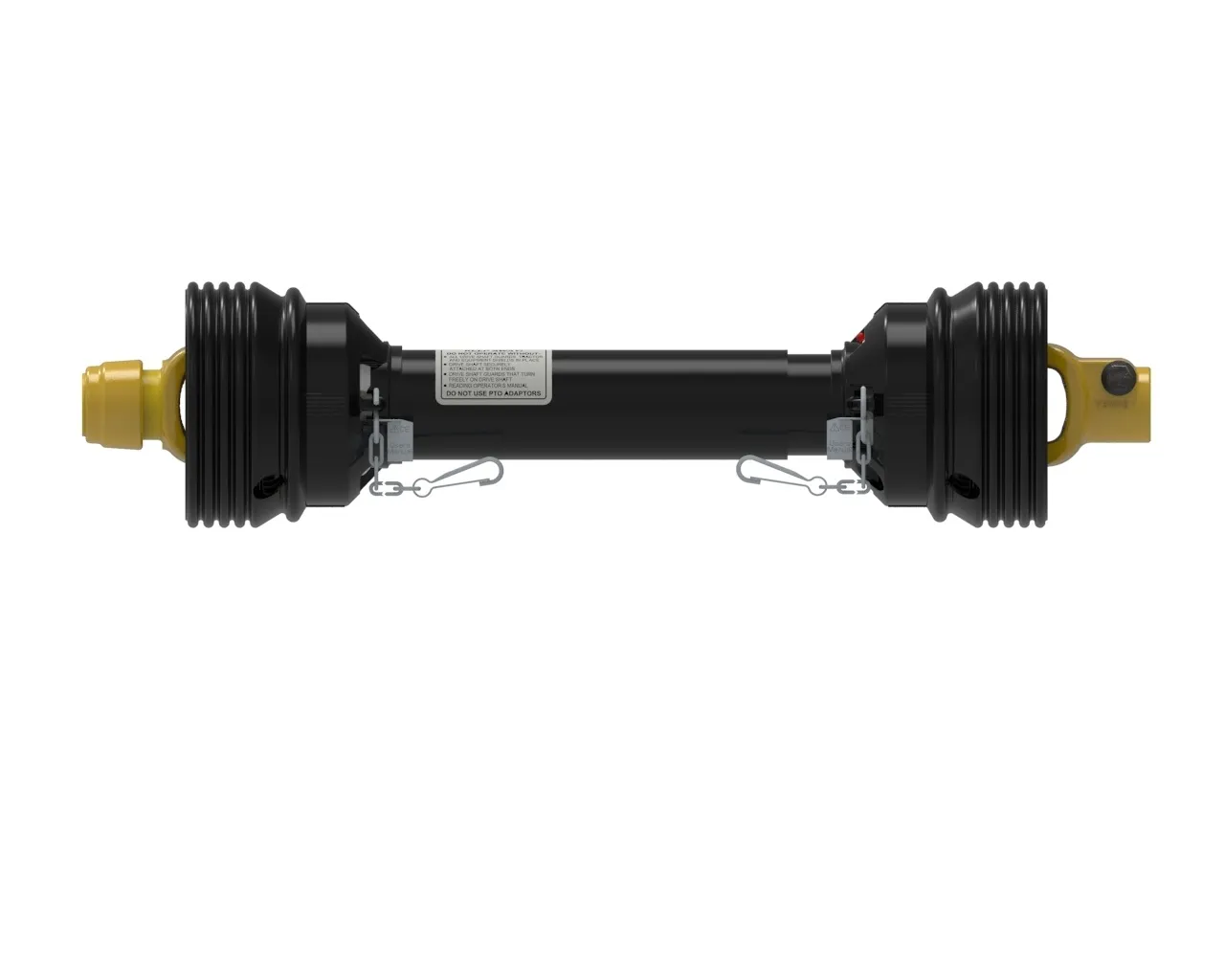
EVER-POWER TMR Shafts utilize:
- CV Wide-Angle Cones: The guard cone on the tractor side is extra-wide and flexible to accommodate the 80-degree bend without exposing the joint.
- Service Access: Our guards have aligned grease access holes. Operators can grease the CV centering ball without dismantling the safety shield, encouraging better maintenance.
- Robust Chains: Heavy-duty chains anchor the guard. In a feedlot, cows often rub against equipment; the guard must be tough enough to survive this.
Material Science: Built for 365 Days
Feedlots never close. The equipment must be durable.
Cold Drawn Star Tubing: We use cold drawn steel for the profile tubes. This hardens the surface and ensures tight tolerances. The Star profile minimizes the risk of the tube “wallowing out” under the cyclic loading of mixing augers.
High-Temp Grease: The CV joint generates heat during turns. We use a Lithium Complex Blue Grease with a drop point of 260°C to ensure the centering ball stays lubricated even after hours of continuous operation.
Case Study: The Dairy in Carambeí
Client Profile: A high-tech dairy farm in Carambeí (PR) milking 1,500 cows.
The Problem: The farm was breaking PTO shafts on their 24m³ vertical mixer during cold winter mornings. The hydraulic oil in the planetary gearbox was thick, and the wet feed had settled overnight. The “dead start” torque snapped the standard Series 8 cross kits.
The EVER-POWER Solution: We upgraded them to a Series 8 CV Shaft with a “Soft-Start” 4-Plate Friction Clutch. We adjusted the clutch tension to slip slightly for 2 seconds upon startup.
The Result: The momentary slip allowed the tractor engine to build RPM before full load was applied to the mixer. The shock load was absorbed by heat in the clutch pack (which is designed for it) rather than stress in the steel joints. Shaft breakage was eliminated. The farm has run for 18 months with zero driveline downtime.
Maintenance: The “CV Ball” Rule
The CV joint is the most expensive and most neglected part.
- Grease the Ball: The centering disk/ball inside the CV joint takes the entire thrust load of the angle. It MUST be greased every 8 hours. If it runs dry, it explodes.
- Burnish the Clutch: Before the rainy season, loosen the clutch springs and slip the clutch to polish off rust. A rusted clutch is a solid coupling and offers no protection. Re-tighten to spec.
- Check Tube Overlap: Ensure the shaft has at least 400mm of overlap. In a turn, a short shaft can separate, causing massive damage.
Frequently Asked Questions (FAQ)
Do I really need a CV shaft for my mixer?
Why does my clutch smoke on startup?
Can I use a 540 shaft on a 1000 RPM mixer?
Agri-Market Trends: Precision Feeding
Brazilian feedlots are moving towards Precision Feeding. This involves using scales and software to track every kg of feed. This requires smooth PTO operation to avoid vibrating the load cells. EVER-POWER is developing Low-Vibration Splines specifically for mixers with integrated weighing systems, ensuring that mechanical noise does not interfere with nutritional data.
 ES
ES  EN
EN  RU
RU  FR
FR  DE
DE  PT
PT  JA
JA  AR
AR  IT
IT  ZH
ZH