
The Invisible Link: PTO Shafts for BeiDou & GNSS Precision Agriculture
Silence in the Driveline, Precision in the Field. Harmonizing Mechanical Power with Digital Navigation in the High-Tech Farms of Mato Grosso and Goiás.
Field Notes: The “Phantom Drift” Phenomenon
The adoption of BeiDou Navigation Satellite Systems (BDS) and other GNSS auto-steer technologies (like CHCNAV, FJDynamics, and Trimble) has revolutionized Brazilian agriculture. In the vast, flat fields of Sorriso و Rio Verde, centimeter-level accuracy is the standard. However, integrating high-tech avionics with heavy-duty mechanics creates unexpected challenges.
The Problem: The Inertial Measurement Unit (IMU). This sensor, mounted on the tractor chassis or cab, acts as the “inner ear” of the auto-steer system, detecting roll, pitch, and yaw. It is incredibly sensitive to vibration.
In 2024, we investigated complaints of “Line Jitter” and “Steering Oscillation” on tractors pulling PTO-driven vacuum planters and fertilizer spreaders. The GPS signal was perfect, yet the tractor wandered. The culprit? A Vibrating PTO Shaft. An unbalanced or worn shaft spinning at 540 or 1000 RPM creates a harmonic frequency that travels through the tractor frame. This mechanical noise confuses the IMU, causing the steering wheel to twitch as the computer tries to correct for a “turn” that isn’t happening.

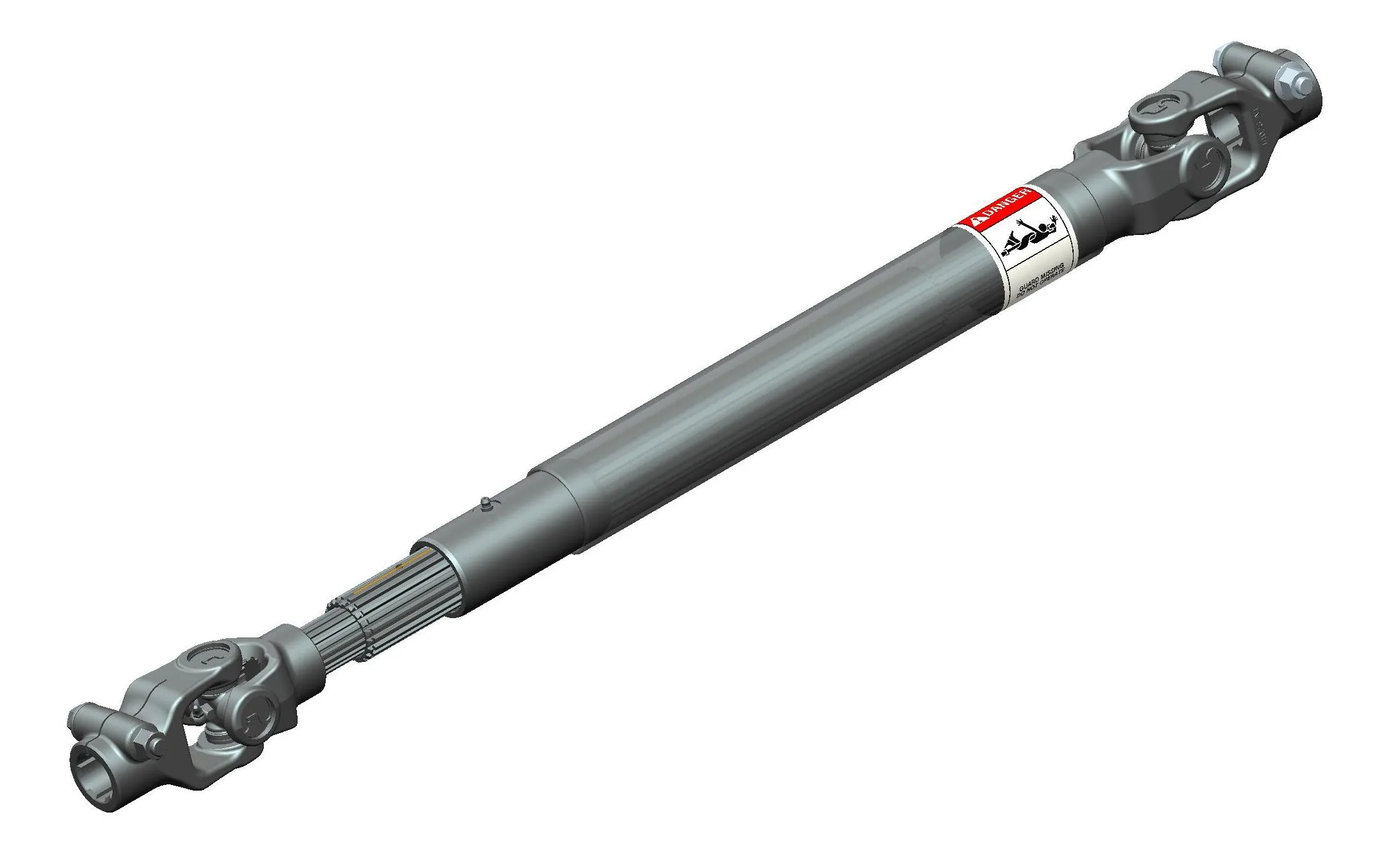
The EVER-POWER Solution: We introduced the Series 6 “Silent-Sync” Precision Driveline. Unlike standard tiller shafts, these units are Dynamically Balanced to ISO Grade G6.3. We use cold-drawn “Star” tubing with tight-tolerance slide fits to eliminate radial rattle. By removing the vibration source at the back of the tractor, we stabilized the sensor readings at the front, restoring 2.5cm accuracy to the planting lines.
Technical Specifications & Engineering Parameters
For precision agriculture, the PTO shaft is no longer just a power transmitter; it is a critical component of the guidance loop. Smoothness is as important as strength. Below are the specs for our Precision Series.
| Parameter ID | Specification Category | Technical Value / Standard |
|---|---|---|
| 01 | Series Classification | Series 6 (Planters) / Series 8 (Spreaders/Carts) |
| 02 | Nominal Torque (540 RPM) | 830 Nm (S6) / 1,240 Nm (S8) |
| 03 | Nominal Torque (1000 RPM) | 640 Nm (S6) / 980 Nm (S8) |
| 04 | Balancing Standard | ISO 1940-1 Grade G6.3 (Turbine Grade) |
| 05 | Tractor Interface | 1-3/8″ Z6 or 1-3/4″ Z20 (Zero-Lash Spline) |
| 06 | Implement Interface | 1-3/8″ Z6 or 1-3/4″ Z6 |
| 07 | Closed Length (Lz) | 1,010 mm – 1,210 mm (Customizable) |
| 08 | Tube Profile | Star Profile (S5/S6) – 6-Point Contact |
| 09 | Tube Material | ST52 Cold Drawn Precision Steel (Rilsan Coated) |
| 10 | Cross Kit Dimensions | 30.2mm x 92mm (S6) / 35mm x 106.5mm (S8) |
| 11 | Bearing Type | High-Speed Sealed Needle Roller |
| 12 | Safety Device | Cam Clutch (K64) or Friction Clutch (FV) |
| 13 | Torsional Rigidity | High (Minimized “Wind-up”) |
| 14 | Operating Angle | Max 25° (Continuous) / 80° (CV Joint) |
| 15 | Wide Angle (CV) | Essential for Headland Turns (Auto-Turn) |
| 16 | Guard Material | Balanced HDPE (Does not induce wobble) |
| 17 | Guard Certification | NR-12 / ISO 5674 |
| 18 | تشحيم | Synthetic Lithium Complex (Blue) |
| 19 | المعالجة السطحية | Zinc-Nickel Plating (Corrosion/Friction Control) |
| 20 | Telescoping Overlap | Min 300mm (Enhanced Rigidity) |
| 21 | وزن | 28 kg – 55 kg |
| 22 | طلب | Vacuum Planter / Fertilizer Spreader / Grain Cart |
| 23 | ضمان | 2 Years (Balance & Structure) |
| 24 | Origin Compatibility | John Deere, Case IH, Stara, Jumil, KF |
The Physics of Interference: Why Balance Matters
How does a mechanical shaft affect a digital satellite signal? It comes down to frequency and harmonics.
1. The IMU Sensitivity (Unidade de Medição Inercial)
The IMU uses micro-electromechanical (MEMS) gyroscopes to keep the tractor straight when the satellite signal is momentarily blocked or to calculate terrain compensation.
The Conflict: A standard PTO shaft spinning at 540 RPM generates a frequency of 9 Hz. If the shaft is bent or unbalanced, it creates a second harmonic at 18 Hz. This frequency range often overlaps with the IMU’s sampling or filtering frequencies.
The Result: The auto-steer ECU interprets this mechanical vibration as the tractor “sliding” or “rolling” on a slope. It sends a correction signal to the steering valve. The tractor jerks to correct a movement that never happened.
The Solution: Dynamic Balancing. By adding weights to the tube and ensuring concentricity, we reduce the vibration amplitude to below the IMU’s noise floor.

2. Torsional Stability for Rate Control
Precision planting (Plantio de Precisão) relies on Variable Rate Technology (VRT). The PTO often drives the vacuum fan or the central seed hopper blower.
The Issue: If the PTO shaft has “slop” (backlash) in the telescoping tubes or U-joints, the rotational speed of the fan fluctuates.
The Consequence: Fluctuating fan speed leads to variable vacuum pressure. This causes skips or doubles in seed placement.
The Solution: Star Profile with Glide Coating. The 6-lobe star profile offers minimal rotational play. We coat the inner tubes with a low-friction polymer (Rilsan) to ensure a tight fit that still telescopes freely, delivering steady, uninterrupted power to the seed metering systems.
3. The Auto-Turn Geometry
Advanced BeiDou systems offer “Headland Turn Automation” (Manobra de Cabeceira Automática). The tractor turns itself at the end of the row.
The Stress: The robot turns the steering wheel faster and sharper than a human. This puts sudden angular stress on the PTO shaft if the implement is not lifted perfectly in sync.
The Solution: 80° CV Joints. A Constant Velocity joint is mandatory. It allows the automated system to execute sharp U-turns without the operator needing to disengage the PTO, maintaining hydraulic pressure for the planter lift assist wheels.
Operational Context: High-Tech Farming
In Brazil, “Agriculture 4.0” is the standard for commodity crops.
Scenario A: High-Speed Planting (Plantio em Alta Velocidade)
Context: Using a 40-row Stara or John Deere planter at 10-12 km/h.
Machine: Central fill planter with PTO-driven vacuum and alternator.
Requirement: Series 6 Balanced. The PTO drives a generator or hydraulic pump. Any vibration here not only affects steering but can damage the onboard alternator bearings. Smoothness is critical for the electrical health of the implement.

Scenario B: Fertilizer Spreading (Distribuição de Sólidos)
Context: Twin-disc spreaders (e.g., Kuhn, Amazone) applying variable rates based on a prescription map.
Challenge: RPM Consistency. The spread width depends entirely on the disc RPM.
Requirement: Constant Velocity (CV). As the tractor navigates contour lines (curvas de nível), a standard shaft would cause the spinner speed to pulse, creating “striping” in the fertilizer pattern. A CV shaft ensures the discs spin at a constant 540 RPM regardless of the terrain angle.
Interchangeability & Systems Integration
Our shafts are compatible with the major global and domestic brands driving the Brazilian ag-tech boom.
Fitment Guide:
EVER-POWER Precision shafts are engineered for:
- Auto-Steer Systems: Validated for use with John Deere StarFire™, Trimble™, CHCNAV™, and FJDynamics™ equipped tractors.
- Implements:
- Planters: Stara (Princesa/Estrela), Jumil, Tatu Marchesan.
- Spreaders: Jacto (Uniport/Tellus), Kuhn (Axis), Amazone.
- Grain Carts: Jan, GTS (utilizing PTO for auger and scales).
*Disclaimer: OEM names are for reference only. EVER-POWER is an independent manufacturer.
Compliance with Brazilian Regulatory Standards (NR-12)
NR-12 is the law. In high-tech farming, safety extends to the equipment itself.
The “Balanced” Guard
A wobbling safety guard is a vibration source.
EVER-POWER Precision Shafts utilize:
- Balanced Plastic Construction: The guard tubes are extruded with uniform wall thickness to ensure they don’t induce wobble.
- Precision Bearings: The guard rides on machined races, not loose nylon rings. This keeps the guard concentric with the shaft.
- Stationary Operation: Chains must be used. A stationary guard does not contribute to rotating mass imbalance.

Material Science: The “Coated” Advantage
To achieve the smoothness required for precision ag, we look beyond bare steel.
Rilsan (Nylon-11) Coating: We coat the male telescoping tube with Rilsan. This creates a polymer-on-steel slide interface.
Benefits:
1. Vibration Damping: The polymer layer absorbs high-frequency noise from the gearboxes.
2. Low Friction: The shaft telescopes with 50% less force, reducing the axial load on the tractor PTO bearings (and the chassis).
3. Zero Maintenance: The coating is self-lubricating, though light greasing is recommended for sealing.
Case Study: The Soybean Farm in Rio Verde
Client Profile: A 3,000-hectare soybean producer in Rio Verde (GO) using BeiDou-based auto-steer kits (CHCNAV) on older John Deere 7J tractors.
The Problem: When planting at speeds over 8 km/h, the auto-steer would “snake” (oscillate), creating wavy rows. Diagnostics showed the GPS signal was fine, but the IMU was registering excessive “noise.” The farmer was using cheap, aftermarket PTO shafts on his vacuum planters.
The EVER-POWER Solution: We replaced the shafts with Series 6 Balanced “Silent-Sync” Shafts.
The Result: The IMU noise floor dropped by 70%. The auto-steer system locked onto the line immediately. The “snaking” disappeared, allowing the farmer to plant at full speed (10 km/h) with perfect straightness. The investment in premium shafts paid for itself in fuel savings and reduced operator fatigue in the first week.
Maintenance: Keeping the Balance
A balanced shaft stays balanced only if it stays clean and straight.
- Clean the Tube: Dried mud on the PTO tube acts like a wheel weight. It throws the shaft out of balance. Wash the shaft daily during planting.
- Check for Dents: A dent in the profile tube creates friction and imbalance. If a tube is dented, replace it; do not hammer it back.
- Phase Alignment: If you separate the shaft, you must reassemble it with the yokes aligned (arrows matching). Out-of-phase assembly creates velocity fluctuations that confuse the VRT controllers.
Frequently Asked Questions (FAQ)
How does a PTO shaft affect my GPS?
Can I use a standard shaft if I drive slowly?
What is G6.3 Balancing?
Agri-Market Trends: Autonomous Tractors
Brazil is seeing the introduction of fully Autonomous Tractors (Solinftec, Jacto). These machines have no operator to feel vibration. They rely entirely on sensors. For these robots, the mechanical driveline must be “invisible” to the sensors—perfectly smooth and reliable. EVER-POWER is already prototyping Sensor-Embedded Shafts that can report vibration levels directly to the autonomous tractor’s AI, predicting failure before it stops the robot.
“` “`
 AR
 EN
 ES
 RU
 FR
 DE
 PT
 JA
 IT
 ZH