
The Hardware of Data: PTO Shafts for Operation Quality Monitoring
Bridging Mechanics and Telemetry in Agriculture 4.0. Enabling Real-Time Torque, RPM, and Efficiency Analysis for Smart Farms in Mato Grosso and Paraná.
Field Notes: The Digital Transformation in Non-Me-Toque
In the epicenter of Brazilian precision agriculture, cities like Non-Me-Toque (RS) Und Lucas do Rio Verde (MT) are witnessing a fundamental shift. The tractor and implement are no longer just mechanical beasts; they are data centers. Operation Quality Monitoring Terminals (Monitores de Qualidade da Operação) are now standard in high-end contracting. These terminals track not just where the machine went (GPS), but how hard it worked Und how well it performed.
The Power Take-Off (PTO) shaft is the critical vein through which the tractor’s energy flows to the implement. In the past, this was an unmeasured variable. Farmers knew the engine RPM, but they had no idea how much torque was actually reaching the soil or the crop.
The Problem: Blind Power. Without data from the PTO, a Quality Monitor cannot accurately calculate:
1. Soil Compaction Real-Time: High torque on a rotary hoe or subsoiler indicates hardpan spots.
2. Crop Density: High load on a forage harvester suggests varying biomass yield.
3. Implement Efficiency: Is the baler slipping? Is the fertilizer spreader maintaining constant disc speed on hills?
Furthermore, standard vibrating PTO shafts introduce “mechanical noise” that confuses sensitive torque sensors mounted on modern gearboxes.

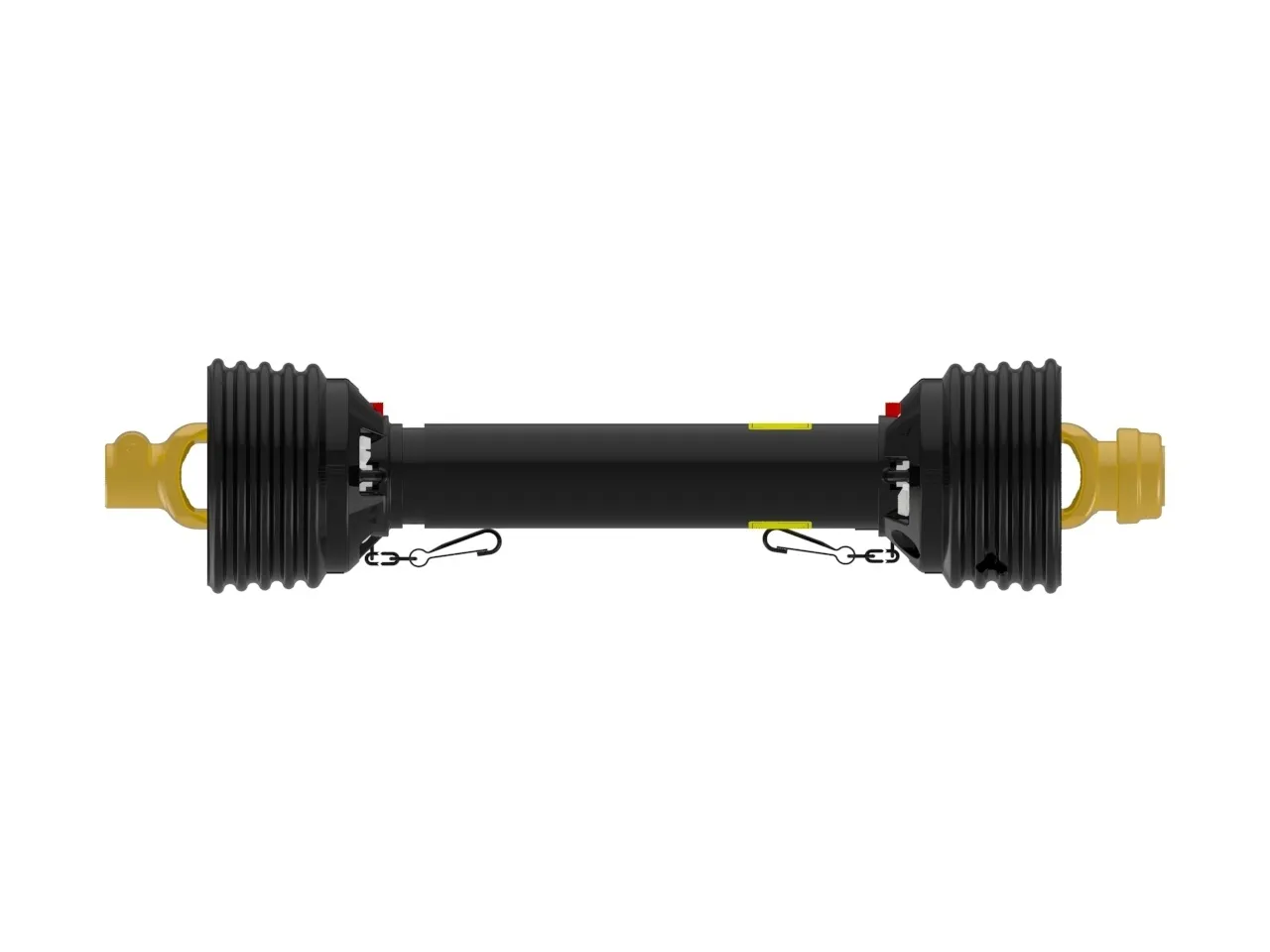
The EVER-POWER Solution: We introduced the Series 10 “Data-Link” Precision Driveline. While this shaft looks like a mechanical component, its manufacturing tolerances are tighter than aerospace standards. It features Zero-Backlash Splines Und G6.3 Dynamic Balancing. Why? Because to measure torque accurately, you must eliminate the noise of vibration. This shaft serves as the stable platform for Telemetric Torque Sensors, allowing the Quality Monitor to map power consumption across the field, turning horsepower into agronomic data.
Technical Specifications & Engineering Parameters
For Smart Farming, the PTO shaft requires mechanical rigidity to ensure data integrity. Elasticity or play in the shaft leads to false sensor readings. Below are the specs for our Digital Agriculture Series.
| Parameter ID | Specification Category | Technical Value / Standard |
|---|---|---|
| 01 | Series Classification | Series 8 (Sensored Implements) / Series 10 (Heavy Duty Telemetry) |
| 02 | Nominal Torque (540 RPM) | 1,240 Nm (S8) / 1,850 Nm (S10) |
| 03 | Nominal Torque (1000 RPM) | 980 Nm (S8) / 1,450 Nm (S10) |
| 04 | Data Compatibility | ISOBUS Class 3 (TIM) Ready |
| 05 | Tractor Interface | 1-3/4″ Z20 (High HP Precision Spline) |
| 06 | Implement Interface | 1-3/4″ Z6 or Flange Mount (For Torque Transducers) |
| 07 | Closed Length (Lz) | 1,010 mm – 1,410 mm (Customizable) |
| 08 | Tube Profile | Involute Spline (S10) – Zero Rotational Play |
| 09 | Tube Material | 42CrMo4 Heat Treated Alloy Steel |
| 10 | Cross Kit Dimensions | 35mm x 106.5mm (S8) / 42mm x 104mm (S10) |
| 11 | Bearing Type | Precision Ground Needle Roller (Low Noise) |
| 12 | Safety Device | Torque Limiter (Clutch) or Electronic Cut-out |
| 13 | Signal Stability | Balanced to G6.3 to prevent sensor drift |
| 14 | Operating Angle | Max 25° (Continuous) / 80° (CV Joint) |
| 15 | Wide Angle (CV) | Essential for Headland Turn Automation |
| 16 | Guard Material | Non-Conductive Anti-Static Polymer |
| 17 | Guard Certification | NR-12 / ISO 5674 |
| 18 | Schmierung | Synthetic Long-Life (Sensor Safe) |
| 19 | Oberflächenbehandlung | Black Oxide or Zinc-Nickel (Non-Reflective) |
| 20 | Telescoping Overlap | Min 400mm (Maximum rigidity for sensor accuracy) |
| 21 | Gewicht | 45 kg – 80 kg |
| 22 | Anmeldung | Variable Rate Spreader / Smart Baler / Planter |
| 23 | Garantie | 2 Years (Structure & Balance) |
| 24 | Origin Compatibility | Solinftec, Climate FieldView, Jacto Otmis, Trimble |
The Physics of Measurement: Converting Steel to Signal
How does a PTO shaft influence an Operation Quality Monitor? It is all about the quality of the mechanical link.
1. Torsional Rigidity and Hysteresis
Modern tractors use TIM (Tractor Implement Management). The implement tells the tractor how fast to drive based on the load.
The Physics: The load is measured via torque on the PTO. If the PTO shaft tube twists excessively under load (elastic deformation) and then snaps back (hysteresis), the torque sensor reads false spikes.
The Consequence: The Quality Monitor thinks the implement is hitting a rock and stops the tractor unnecessarily, or it miscalculates the yield map.
The Solution: Splined Solid Bar Profiles. Instead of hollow tubes, Series 10 shafts use solid splined bars. These have incredibly high torsional stiffness. This ensures that 100% of the resistance at the implement is instantly reflected at the sensor, providing “High Definition” data to the farm management software.

2. Vibration and Signal Noise (Ruído de Sinal)
Quality Monitoring Terminals use accelerometers and strain gauges.
The Interference: An unbalanced PTO shaft vibrating at 1000 RPM creates a mechanical frequency of 16.6 Hz. This mechanical noise can drown out the delicate signals from grain flow sensors or load cells.
The Solution: Precision Balancing. We treat these agricultural shafts like industrial turbine shafts. By balancing them to G6.3, we create a “quiet” mechanical environment. This improves the Signal-to-Noise Ratio (SNR) for all onboard electronics, leading to cleaner maps and more accurate variable rate application.
3. The Automation of Headlands
Quality Monitoring implies 100% field coverage. To achieve this, automated headland turns are used.
The Geometry: The computer executes turns faster and sharper than a human. This places sudden angular stress on the PTO.
The Solution: 80° CV Joints. A Constant Velocity joint is mandatory for automated turns. It ensures that the RPM stays constant during the turn. If RPM fluctuates (as with a standard U-joint), the Quality Monitor will record a “Quality Fault” (e.g., uneven fertilizer spread) on every turn. The CV joint guarantees uniform application even in the corners.

Operational Context: The “Connected” Farm
How does the PTO shaft fit into the digital ecosystem of a Brazilian farm?
Scenario A: Variable Rate Fertilizer Spreading (Taxa Variável)
Context: A Jacto or Kuhn spreader applying fertilizer based on a prescription map.
The Data Loop: The Quality Monitor checks the disc RPM vs. Forward Speed.
The PTO Role: If the PTO shaft slips or vibrates, the spread width changes. The monitor detects this as an error.
Requirement: Zero-Slip Profiling. We use Star profiles with tight tolerances to ensure the PTO RPM matches the tractor engine RPM exactly, ensuring the spread width matches the digital map perfectly.
Scenario B: “Smart” Baling (Enfardamento Inteligente)
Context: A Krone or Vermeer baler equipped with moisture and weight sensors.
The Data Loop: The baler adjusts the tractor speed to maintain constant flake density.
The PTO Role: The PTO shaft transmits the compression load. The torque reading tells the tractor to slow down if the windrow gets heavy.
Requirement: Integrated Friction Clutch. While the electronic system protects against general overload, a physical Friction Clutch is still needed for instantaneous shock loads (rocks). Our clutches are designed to work in harmony with torque sensors, slipping only when the mechanical limit is reached, not during normal high-load compression.

Interchangeability & Systems Integration
The “Smart Farm” relies on interoperability (ISOBUS). Our shafts are the physical connector.
Fitment Guide:
EVER-POWER Precision shafts are compatible with systems integrated into:
- John Deere™ (Operations Center): Supporting JDLink™ connected implements like balers and manure spreaders.
- CNH Industrial™ (Case IH / New Holland): Compatible with AFS/PLM Connect systems requiring high-stability drivelines.
- Agocontrol™ / Trimble™: Providing the mechanical stability needed for retrofit monitoring kits.
- Solinftec™: Our shafts provide the reliable uptime required for Solinftec’s real-time machine learning algorithms to function without mechanical noise interference.
*Disclaimer: OEM names are for reference only. EVER-POWER is an independent manufacturer.
Compliance with Brazilian Regulatory Standards (NR-12)
NR-12 is the baseline. But in digital farming, safety also means Data Integrity.
The “Sensor-Safe” Guard
Spinning objects create static electricity and magnetic fields.
EVER-POWER Smart Shafts utilize:
- Non-Conductive Materials: Our guards are made of specific polymers that do not build up static charge. Static discharge can fry the wireless transmitters of torque sensors mounted on the shaft.
- Vibration-Free Guarding: A wobbling guard can hit the sensor cables. Our guards ride on precision bearings to ensure they stay concentric and do not interfere with the wiring harnesses of the monitoring terminal.
- Access Windows: Designed to allow easy access to sensor battery compartments or calibration ports without removing the entire safety shield.
Material Science: Consistency is Quality
For a computer to analyze data, the mechanical baseline must be constant.
Thermal Stability: Agricultural work heats up the PTO. Steel expands. This expansion can change the friction coefficient of telescoping tubes. We use Moly-Coated Splines which maintain a constant friction level regardless of temperature. This ensures that the “power loss” through the shaft remains constant, allowing the Quality Monitor to calculate the net power to the implement accurately.
Fatigue Resistance: Automated systems run machinery harder and longer than humans. We use Shot-Peened Yokes to increase fatigue resistance by 30%, ensuring the shaft survives the 24/7 harvest cycles of the digital farm.
Case Study: The Smart Farm in Balsas
Client Profile: A 10,000-hectare corporate farm in Balsas (Maranhão) fully integrated with the “Climate FieldView” platform.
The Problem: The farm was using PTO-driven subsoilers to map soil compaction based on torque load (load mapping). However, the maps showed erratic “hard spots” that didn’t exist. Soil tests confirmed the ground was soft. The error was traced to the PTO shafts: they were old, worn, and binding. Every time the shaft bound up during telescoping, the torque sensor spiked, creating a false “compaction zone” on the digital map.
The EVER-POWER Solution: We replaced the fleet with Series 10 Splined Shafts with Low-Friction Coating.
The Result: The torque data smoothed out immediately. The new maps accurately reflected the true soil resistance. The farm was able to perform Variable Rate Tillage, tilling only the areas that actually needed it. This saved 15% in fuel and reduced tractor engine wear. The investment in precision shafts paid off in a single soil preparation cycle.
Maintenance: Protecting the Data Stream
Maintaining a Smart PTO is about protecting the mechanical precision.
- Keep Splines Clean: Dirt increases friction. Friction skews torque data. Clean and re-grease the splines weekly with high-quality Moly grease.
- Check U-Joint Play: Any “clicking” or play in the cross kit creates noise in the vibration data. Replace U-joints at the first sign of wear to keep the sensor signal clean.
- Guard Clearance: Ensure the safety guard is not rubbing on the sensor ring or cables. Friction creates heat and static, enemies of electronics.
Frequently Asked Questions (FAQ)
Can I put a torque sensor on any PTO shaft?
Does this shaft work with ISOBUS implements?
Why is balancing so important for monitoring?
Agri-Market Trends: The Shaft as a Sensor
The future of Brazilian agriculture is the “Talking PTO”. EVER-POWER is currently testing prototypes with Embedded Wireless Sensors built directly into the yoke manufacturing process. These shafts will not only transmit power but will broadcast their own temperature, torque, and vibration levels directly to the Operation Quality Monitor via Bluetooth, predicting their own maintenance needs and preventing downtime before it happens.
 DE
DE  EN
EN  ES
ES  RU
RU  FR
FR  PT
PT  JA
JA  AR
AR  IT
IT  ZH
ZH