
The Backbone of Earthmoving: Drivelines for Bulldozers
Powering the Winches and Pumps of the Construction World. From Amazonian Logging to Urban Infrastructure, Connecting Engine Torque to Hydraulic Might.
Field Notes: Beyond the Blade
When we think of a **Bulldozer (Trator de Esteira)**, we think of the blade pushing earth. However, the true utility of these machines often lies at the rear or deep within the belly pan. In the dense forests of **Pará**, bulldozers are equipped with massive **Logging Winches (Guinchos Florestais)**. In mining operations in **Minas Gerais**, they drive high-capacity **Hydraulic Pumps**.
These applications utilize a specialized form of PTO shaft. Unlike the agricultural tractor shaft which powers a mower, a bulldozer driveline is often a **Short-Coupled Industrial Cardan** connecting the engine flywheel to a torque converter, or the transmission PTO output to a winch gearbox.
The Operational Stress:
1. Dead Drag Shock (O Tranco do Guincho): When a logging winch engages to pull a 20-ton hardwood log out of the mud, the cable snaps tight. The driveline experiences a shock load that can be 400% of the nominal torque.
2. Chassis Flex: Although bulldozers look rigid, the frame flexes under heavy load. A rigid shaft would shatter. The Cardan shaft must accommodate this misalignment while transmitting hundreds of horsepower.
3. Heat and Confinement: These shafts often operate inside the machine’s belly, surrounded by hot hydraulic lines and engine heat, with little airflow.

The EVER-POWER Solution: We engineered the Series 12 “Earth-Mover” and Mechanics-Style Drivelines. These shafts depart from standard agricultural designs. We use **Flange Yokes (Wing Style)** for secure bolt-on connections that withstand extreme vibration. The cross kits are **Wing Bearing** types, designed for higher torque density than standard round bearings. This ensures that when the dozer is deep in the mud, the power delivery to the winch or tracks is absolute.
Technical Specifications & Engineering Parameters
Bulldozer applications require adherence to SAE and Mechanics industrial standards. These are not standard 6-spline farm shafts. Below are the specs for our Heavy Construction Series.
| Parameter ID | Specification Category | Technical Value / Standard |
|---|---|---|
| 01 | Series Classification | Mechanics 5C, 6C, 7C, 8.5C / Series 10, 12 |
| 02 | Nominal Torque (Continuous) | 2,500 Nm – 8,000 Nm |
| 03 | Max Shock Load Rating | 15,000 Nm (Winch Stall Torque) |
| 04 | Flange Interface | Mechanics Wing Style or DIN 120/150 Flange |
| 05 | Spline Interface | SAE 10-Spline, 14-Spline (Coarse Pitch) |
| 06 | Closed Length (Lz) | 300 mm – 800 mm (Ultra-Short Coupling) |
| 07 | Tube Profile | Solid Spline Bar or Heavy Wall DOOC |
| 08 | Tube Material | 4340 Chromoly Steel (Heat Treated) |
| 09 | Cross Kit Dimensions | Wing Bearing Type (Bolt-on Caps) |
| 10 | Bearing Type | High-Load Needle Roller (Impact Resistant) |
| 11 | Misalignment Capacity | Max 15° (Chassis Flex Compensation) |
| 12 | Balancing Standard | G6.3 @ 2500 RPM (Engine Redline) |
| 13 | Operating Temp | -30°C to +120°C (Internal Engine Bay) |
| 14 | Guard Material | Steel Casing or Heavy HDPE (External Winch) |
| 15 | Lubrificação | High-Temp Moly Grease (EP2) |
| 16 | Tratamento de superfície | Phosphate Coating or Industrial Yellow Paint |
| 17 | Slip Assembly | Glidecoat Spline (Low Friction under Load) |
| 18 | Clutch Type | None (Direct Drive) or Torque Converter |
| 19 | Peso | 25 kg – 80 kg |
| 20 | Aplicativo | Logging Winch / Hydraulic Pump / Fan Drive |
| 21 | Garantia | 1 Year (Industrial Construction) |
| 22 | Origin Compatibility | Caterpillar, Komatsu, Dressta, Liebherr, Shantui |
The Physics of Force: Pulling and Pumping
The bulldozer’s PTO system operates differently from a tractor. It is usually a “Live” PTO connected directly to the engine or a transmission-driven shaft for auxiliary functions.
1. The Mechanics Wing Bearing (O Rolamento de Asa)
In agriculture, we use round bearing cups held by snap rings. In heavy earthmoving, we use Wing Bearings (Mechanics Style).
The Physics: A wing bearing bolts directly to the yoke face. This eliminates the “spring” of a yoke ear and provides a much more rigid path for torque. It also allows the shaft to be removed radially (from the side) without disturbing the mounted machinery (pump or winch), which is critical for maintenance in the field.
The Benefit: Extreme torque capacity and serviceability. When a 50-ton dozer vibrates, snap rings can fly out. Bolted wing bearings stay put.
2. The Winch “Stall” (O Travamento do Guincho)
Logging winches (like Hyster or Allied) are PTO driven.
The Scenario: The operator is skidding a log. The log hits a stump. The winch drum stops instantly.
The Stress: The engine is at full throttle (2000 RPM). The driveline takes the full kinetic energy of the engine flywheel.
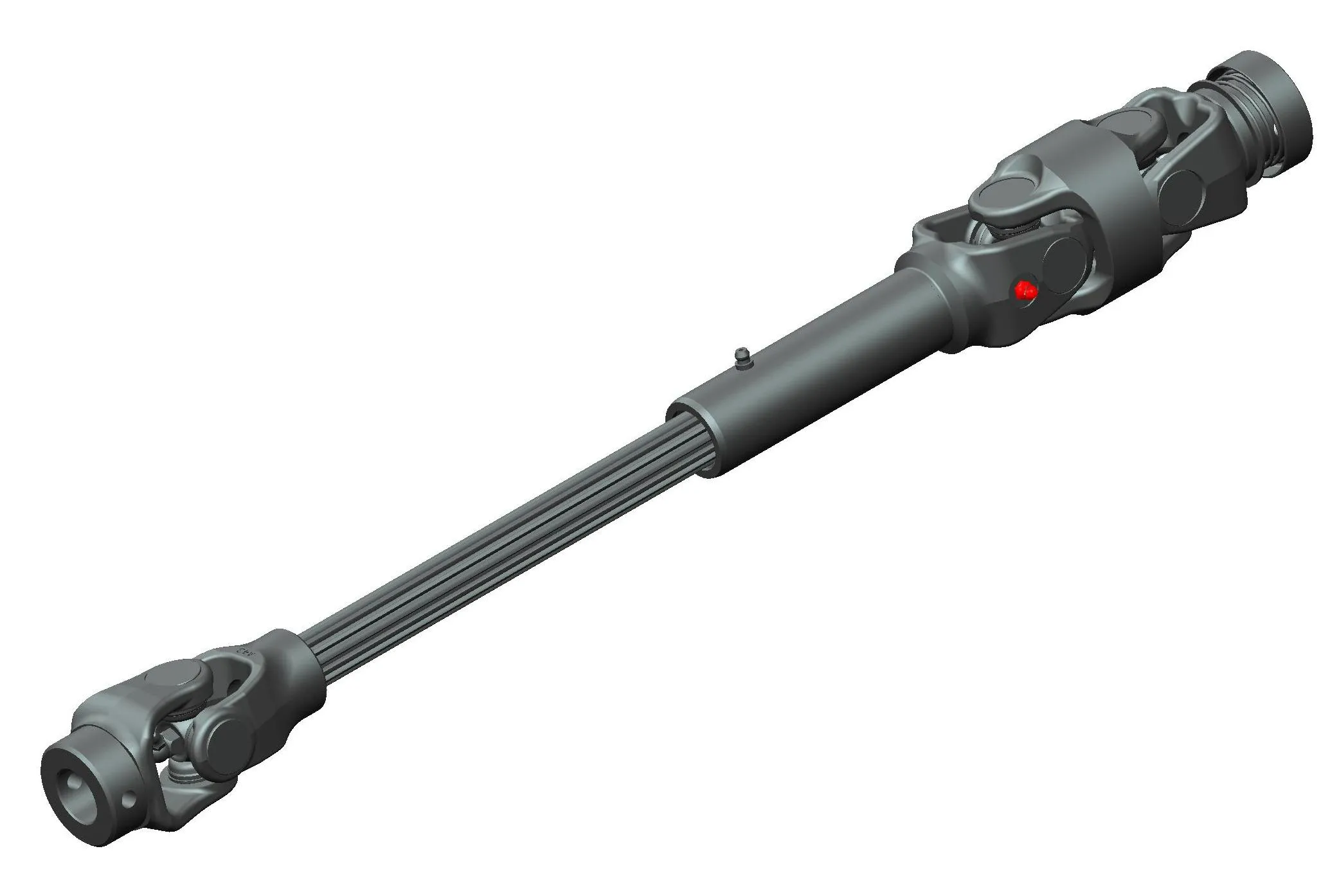
The Solution: Solid Bar Slip Yokes. We do not use hollow tubes for winch drives. We use solid heat-treated bars with long spline engagement. This solid mass acts as a torsion spring, twisting slightly to absorb the peak shock load before it snaps the input shaft of the winch.
3. Pump Drive Harmonics
Many dozers use a front or rear PTO shaft to drive the main hydraulic pumps.
The Risk: If this shaft is unbalanced or slightly bent, it vibrates at engine speed. This vibration travels into the hydraulic pump.
The Failure: “Fretting” of the pump splines and cavitation damage to the pump internals due to vibrational resonance.
The Solution: Dynamic Balancing G6.3. Even though these are rough machines, the pump drive shafts must be balanced like turbine components. We use welded weights and precision straightening to ensure the hydraulic system receives smooth rotary input.
Operational Context: Earth and Iron
The applications are specific to heavy industry.
Scenario A: Forestry Skidding (Arrasto de Toras)
Context: A Caterpillar D6 or Komatsu D61 equipped with a rear winch working in the Amazon.
Challenge: Debris and Impact. Branches and vines constantly whip around the rear of the machine.
Requirement: Fully Enclosed Guarding. While industrial shafts often run naked, forestry winch shafts *must* be guarded to prevent vines from winding around them and ripping out hydraulic lines. We supply heavy-gauge steel or impact-resistant HDPE guards for these external shafts.

Scenario B: Pipelayers (Assentadores de Tubos)
Context: Specialized dozers with side-booms for laying gas pipelines. The winches for the boom and hook are mechanically driven.
Challenge: Precision Control. The load (a pipe) must be lowered millimeters at a time.
Requirement: Zero-Lash U-Joints. Any play in the U-joints translates to “jerky” movement of the load. We use precision-ground cross kits with pre-load to ensure absolute control during delicate lifting operations.
Scenario C: Amphibious Dredging Dozers
Context: Dozers modified for working in swamps or shallow water.
Challenge: Submersion. The driveline is often underwater.
Requirement: Triple-Sealed Bearings. Standard seals fail. We use a “Mud-Block” seal design originally from off-road trucks to keep abrasive swamp water out of the needle bearings.
Interchangeability & Systems Integration
We support the giants of the earthmoving world.
Fitment Guide:
EVER-POWER Construction shafts are engineered replacements for:
- Caterpillar™ (D-Series / Pipelayers): We stock the specific Mechanics flange yokes (5C, 6C, 7C) used on Cat winch drives.
- Komatsu™ (D-Series): Compatible with the pump drive shafts used on Komatsu crawlers.
- Allied Systems™ / Hyster™: Replacement drivelines for the rear-mounted winches commonly fitted to these dozers.
- Shantui™ / LiuGong™: Metric flange adapters for Chinese-manufactured heavy equipment.
*Disclaimer: OEM names are for reference only. EVER-POWER is an independent manufacturer.
Compliance with Brazilian Regulatory Standards (NR-12)
NR-12 applies heavily to construction machinery.
The “Hidden Hazard”
While many dozer shafts are internal, external winch shafts are highly dangerous.
EVER-POWER Construction Shafts utilize:
- Bolt-On Guards: Unlike quick-release tractor guards, construction guards are often bolted to the machine frame for permanence.
- Service Access: Our designs include grease access ports that allow maintenance without removing the safety shield, encouraging safe practices in the field.
Material Science: Built for Abuse
Construction is harder on steel than agriculture.
4340 Chromoly Steel: For the yokes and spline bars, we use 4340 steel. This alloy offers superior toughness and fatigue resistance compared to standard carbon steel. It withstands the shock loading of rock ripping and stump pulling.
Phosphate Coating: Instead of paint which chips off and hides cracks, we use a black phosphate coating. This prevents rust but allows inspectors to see stress cracks developing in the metal during routine maintenance checks.
Case Study: The Logging Operation in Rondônia
Client Profile: A sustainable timber harvesting company in Rondônia using Caterpillar D6 dozers with Allied winches.
The Problem: The original OEM driveshafts were failing every 600 hours. The failure point was the slip spline. The constant extending and compressing of the shaft as the dozer frame flexed over rough terrain was wearing out the splines, causing vibration that eventually shattered the U-joints.
The EVER-POWER Solution: We supplied a Series 12 Shaft with “Glidecoat” Splines. This is a Nylon/Molybdenum coating on the male spline that reduces friction by 70%.
The Result: The friction reduction allowed the shaft to telescope freely even under full torque load. The “axial thrust” on the U-joints was eliminated. Shaft life extended to over 2,500 hours. The smoother operation also reduced seal leaks on the winch input shaft.
Maintenance: The Heavy Iron Protocol
Dozers run hot and dirty.
- Grease the Spline: This is the most critical point. Pump grease into the slip yoke zerk until it purges. This flushes out dirt and water. Do this daily in wet conditions.
- Check Flange Bolts: Mechanics-style flanges rely on bolt tension. Check the torque on the mounting bolts every 250 hours. Vibration loosens them. A loose shaft at 2000 RPM destroys everything around it.
- Inspect for Bends: If a log hits the shaft, it might bend slightly. A bent shaft will vibrate and kill the winch bearings. Use a dial indicator to check runout.
Frequently Asked Questions (FAQ)
Can I replace a Mechanics joint with a standard Spicer joint?
My shaft vibrates when the winch is under load. Why?
Do you make shafts for vintage dozers?
Agri-Market Trends: Electric Drive Dozers
The industry is moving towards Electric Drive (Caterpillar D6 XE). These machines use electric motors for the tracks but still often use mechanical PTOs for winches and pumps. EVER-POWER is developing Insulated Drivelines to prevent stray electrical currents from damaging bearings in these high-voltage hybrid machines.
 PT
PT  EN
EN  ES
ES  RU
RU  FR
FR  DE
DE  JA
JA  AR
AR  IT
IT  ZH
ZH