
The Battle Against Corrosion: PTO Shafts for Manure & Waste Management
Reliable Power for “Esterqueiras” and Scrapers. Engineered to Survive Ammonia, Moisture, and Heavy Slurry in Brazilian Dairy and Swine Production.
Field Notes: The Environment That Eats Steel
In the intensive livestock hubs of Brazil—such as the swine farms (granjas de suínos) of Santa Catarina and the high-yield dairy free-stalls of Castro (Paraná)—waste management is a critical daily operation. The machinery involved, including Vacuum Tankers (Distribuidores de Esterco Líquido/Esterqueiras), Manure Scrapers (Raspadores), and Pit Agitators (Agitadores de Chorume), operate in the most hostile environment on the farm.
The Problem: The primary enemy is Ammonia. Livestock waste releases high concentrations of ammonia gas and acidic fluids. When combined with the humidity of a washing routine, this creates a corrosive atmosphere that attacks standard steel rapidly.
In 2023, maintenance logs from large cooperatives showed that PTO shafts on manure tankers had a lifespan 50% shorter than those on tillage equipment. The cause? Seized Telescoping Tubes. Rust formed inside the profile tubes, locking them solid. When the operator turned the tractor with a seized shaft, the axial thrust destroyed the vacuum pump gearbox or the tractor’s PTO stub.

The EVER-POWER Solution: We introduced the Series 6 “Bio-Shield” Driveline. This shaft is designed with a “Defense-in-Depth” strategy. We utilize Zinc-Nickel Plating (far superior to standard yellow zinc) on all metal surfaces, including the inner telescoping tubes. We upgraded the cross kits to use Triple-Lip Cassette Seals to prevent liquid slurry from penetrating the needle bearings. This ensures the shaft remains functional and safe, even after years of exposure to the corrosive reality of the feedlot.
Technical Specifications & Engineering Parameters
Equipment in this sector ranges from low-speed scrapers to high-speed vacuum pumps. The common denominator is the need for sealing and corrosion resistance.
| Parameter ID | Specification Category | Technical Value / Standard |
|---|---|---|
| 01 | Series Classification | Series 4 (Scrapers) / Series 6 & 8 (Tankers/Agitators) |
| 02 | Nominal Torque (540 RPM) | 460 Nm (S4) / 830 Nm (S6) / 1,240 Nm (S8) |
| 03 | Nominal Torque (1000 RPM) | 380 Nm (S4) / 640 Nm (S6) / 980 Nm (S8) |
| 04 | Max Shock Load Rating | 3,500 Nm (Agitator Startup) |
| 05 | Tractor Interface | 1-3/8″ Z6 (Standard) or 1-3/8″ Z21 (CV) |
| 06 | Implement Interface | 1-3/8″ Z6, 35mm Keyed, or 40mm Keyed |
| 07 | Closed Length (Lz) | 810 mm – 1,410 mm (Standard Pull-Type) |
| 08 | Tube Profile | Triangular (Coated) or Star Profile |
| 09 | Tube Material | ST52 Cold Drawn Precision Steel (Zinc-Ni Plated) |
| 10 | Cross Kit Dimensions | 27mm x 74.6mm (S4) / 30.2mm x 92mm (S6) |
| 11 | Bearing Type | Cassette Sealed Needle Roller (Liquid Proof) |
| 12 | Safety Device | Shear Bolt (Pumps) or Wide-Angle CV (Tankers) |
| 13 | Operating Angle | Max 80° (CV Joint – Essential for Tankers) |
| 14 | Wide Angle (CV) | Standard on Tractor Side for Vacuum Tankers |
| 15 | Guard Material | Chemical Resistant HDPE (Yellow/Black) |
| 16 | Guard Certification | NR-12 / ISO 5674 |
| 17 | Lubrification | Calcium Sulfonate (Water Resistant Marine Grease) |
| 18 | Traitement de surface | Passivated Zinc-Nickel (Anti-Corrosion) |
| 19 | Telescoping Overlap | Min 300mm (Required for tank stability) |
| 20 | Clutch Reset | Manual (Bolt) / Automatic (CV) |
| 21 | Poids | 18 kg – 45 kg |
| 22 | Application | Liquid Manure Tanker / Pit Agitator / Scraper |
| 23 | Garantie | 1 Year (Corrosion & Structure) |
| 24 | Origin Compatibility | Ipacol, Mepel, Triton, Becker, DeLaval |
The Physics of Slurry: Pumping and Agitating
Moving liquid and semi-solid waste presents specific mechanical challenges related to fluid dynamics and turning geometry.
1. The Vacuum Pump Drive (A Bomba de Vácuo)
Vacuum tankers use a PTO-driven compressor to create a vacuum for filling and pressure for spreading.
The Load: The load is continuous and relatively smooth, but high speed (540 RPM).
The Risk: Vibration. Since the pump runs at high speed, any imbalance in the PTO shaft shakes the pump vanes, leading to seal failure and loss of vacuum.
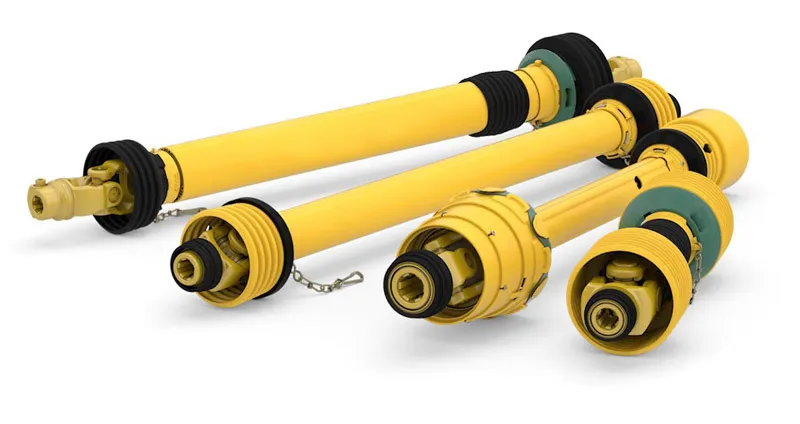
The Solution: Precision Balancing and Shear Bolts. We balance these shafts to G6.3 to ensure smooth pump operation. We incorporate a Shear Bolt yoke to protect the pump rotor if foreign objects (stones) are sucked into the mechanism or if the vanes seize due to lack of oil.
2. The Turning Radius (A Curva da Esterqueira)
Liquid manure tankers are often heavy (10,000+ Liters) and trailed. Maneuvering them in tight barnyards requires sharp turns.
The Physics: Turning a standard U-joint past 30 degrees creates severe velocity fluctuations (“chatter”). This vibration destroys the pump bearings.
The Solution: The Wide-Angle Constant Velocity (CV) Joint. Located at the tractor end, this joint allows the operator to turn 80 degrees while the pump continues to run smoothly. This is essential for spreading manure in irregular fields or turning at headlands without stopping the flow.
3. The Agitator Start-Up (O Agitador de Lagoa)
Before pumping, settled solids in the manure pit must be agitated. This is done with a long PTO-driven propeller.
The Shock: The propeller is submerged in thick sludge. Starting it requires overcoming massive viscous friction.
The Defense: Star Profile Tubing. We use Star profiles because they offer greater surface area for torque transmission than triangular tubes. This prevents the tube from twisting under the “dead start” load of a 5-meter long agitator propeller.

Operational Context: The Brazilian Farmyard
The equipment configuration depends on the type of livestock and the waste consistency.
Scenario A: Swine Effluent (Dejetos de Suínos) – Santa Catarina
Context: Highly corrosive liquid manure stored in covered ponds (biodigesters).
Challenge: Chemical Attack. The air around the ponds is rich in hydrogen sulfide and ammonia.
Requirement: Zinc-Nickel Plating. Paint is not enough. We plate the entire shaft assembly. Zinc-Nickel creates a sacrificial layer that prevents the base steel from rusting even when exposed to corrosive biogas fumes 24/7.
Scenario B: Dairy Barn Scraper (Raspador de Free-Stall)
Context: Automated or tractor-driven scrapers cleaning concrete alleys.
Challenge: Slippery Conditions. The floor is wet and slippery. Safety is paramount.
Requirement: Robust Guarding. Workers and cows are walking near the equipment. The yellow safety guard must be intact, non-rotating, and durable enough to withstand kicks from animals or accidental impacts. Our guards use impact-modified HDPE that remains flexible even in cold southern winters.

Interchangeability & OEM Replacement
We support the major manufacturers of waste handling equipment in Brazil.
Fitment Guide:
EVER-POWER Series 6/8 shafts are engineered replacements for:
- Ipacol™ / Mepel™ (Tankers): Direct replacement for the main vacuum pump drive. We stock the CV versions for trailed units.
- Triton™ / Becker™: Compatible with their range of liquid manure spreaders and agitators.
- DeLaval™ / GEA™ (Scraper Systems): Replacement shafts for the drive units of automated alley scrapers.
- Local Fabrications: Universal fitment for custom-built pump trailers found in regional cooperatives.
*Disclaimer: OEM names are for reference only. EVER-POWER is an independent manufacturer.
Compliance with Brazilian Regulatory Standards (NR-12)
NR-12 is rigorous. In livestock environments, the risk of slips and falls near machinery increases the danger of entanglement.
The “Barnyard” Safety Standard
A spinning shaft in a wet, slippery barn is a high risk.
EVER-POWER Manure Shafts utilize:
- Non-Rotating Guards: The guard rides on bearings and stands still while the shaft spins. If a worker slips and grabs the shaft, the guard does not rotate.
- Full Cone Coverage: The guard cones extend over the U-joints and shear bolt assemblies. No rotating metal is exposed.
- Secure Chains: Robust chains anchor the guard to the machine. In a barn environment, these chains must be checked daily as they can be damaged by animals.
Material Science: The Chemistry of Protection
To survive in a manure pit, steel needs armor.
Zinc-Nickel vs. Painting: Standard paint has micropores. Ammonia gas penetrates these pores, rusting the steel underneath. The paint bubbles and flakes off. Zinc-Nickel plating creates a chemical bond with the steel. It is self-healing (sacrificial) and provides 5x the corrosion resistance of standard yellow zinc.
Calcium Sulfonate Grease: We factory-fill our manure shafts with Calcium Sulfonate grease. This is a “marine grade” grease. It is hydrophobic (repels water) and has excellent natural rust-inhibiting properties, unlike standard Lithium grease which can wash out in wet conditions.
Case Study: The Dairy Cooperative in Castro
Client Profile: A large dairy cooperative in Castro (PR) managing waste from 2,000 cows using 12,000-liter Ipacol tankers.
The Problem: The cooperative was replacing PTO shafts every 6 months. The failure mode was seized telescoping tubes. The humid, ammonia-rich environment caused the inner tubes to rust-weld to the outer tubes. When drivers turned corners, the seized shafts transferred axial loads that shattered the vacuum pump bearings.
The EVER-POWER Solution: We upgraded the fleet to Series 6 “Bio-Shield” Shafts with Zinc-Nickel Plating and CV Joints.
The Result: The plating prevented the rust-welding. The shafts continued to telescope freely even after a year of daily use. The CV joints allowed for tighter turning in the yard without damaging the pumps. Pump bearing failures dropped by 90%, and shaft life extended to over 2 years.
Maintenance: The “Wash-Down” Protocol
Equipment is washed daily. This is good for hygiene but bad for bearings if done wrong.
- Grease AFTER Washing: Never grease before washing. Wash the machine, then grease the PTO shaft. The fresh grease pushes out any water and detergent that may have entered the seals during the high-pressure wash.
- Tube Lubrication: Pull the shaft apart once a month. Wipe the tubes clean of old, contaminated grease. Apply fresh Calcium Sulfonate grease. This is the single most important step to prevent seizing.
- Check Chains: Ensure safety chains are intact. In a corrosive environment, chains can rust and break. Replace them to ensure the guard remains stationary.
Foire aux questions (FAQ)
Why does my PTO shaft vibrate when pumping?
Can I use a painted shaft if I grease it often?
Do I need a shear bolt for an agitator?
Agri-Market Trends: Biogas and Sustainability
Brazil is rapidly adopting Biodigesters to turn waste into energy. This process requires continuous mixing and pumping. The demand for industrial-grade, 24/7 duty cycle PTO shafts for stationary mixers is growing. EVER-POWER is developing Long-Life Maintenance-Free Shafts with advanced seal technology to support this green energy revolution.
 FR
FR  EN
EN  ES
ES  RU
RU  DE
DE  PT
PT  JA
JA  AR
AR  IT
IT  ZH
ZH