
The Power of Densification: PTO Shafts for Feed & Biomass Processing
Fueling the Feedlots of Goiás and the Energy Sector. Heavy-Duty Drivelines for Kneaders (Rousiji), Shredders, and High-Pressure Briquetting Machines.
Field Notes: The Challenge of Fibrous Biomass
In the intensive livestock farming regions of Brazil, such as the dairy basins of Minas Gerais and the beef feedlots (confinamentos) of Goiás, feed efficiency is everything. Farmers process massive amounts of Napier Grass (Capim-Açu), Sugarcane, and Corn Stover.
The machinery used—Forage Kneaders (Desintegradores/Picadores) and Biomass Briquetters (Prensas de Briquete)—subjects the PTO driveline to some of the harshest conditions in agriculture.
The Mechanical Stress Test:
1. The “Kneading” Shock: Unlike simple cutting, a “kneader” (rubbing machine) crushes the plant fiber to release nutrients. This requires high torque and creates violent, rhythmic shock loads as bunches of cane enter the chamber.
2. The Briquetting Pressure: Compressing biomass into solid fuel logs or feed pellets essentially involves forcing material through a die under extreme pressure. If the material moisture content is slightly off, the machine can lock up instantly, creating an “Infinite Torque” scenario.
3. Stationary Duty: These machines often run stationary for 10+ hours a day. Heat buildup in the U-joints and clutches is a major killer of standard agricultural shafts.

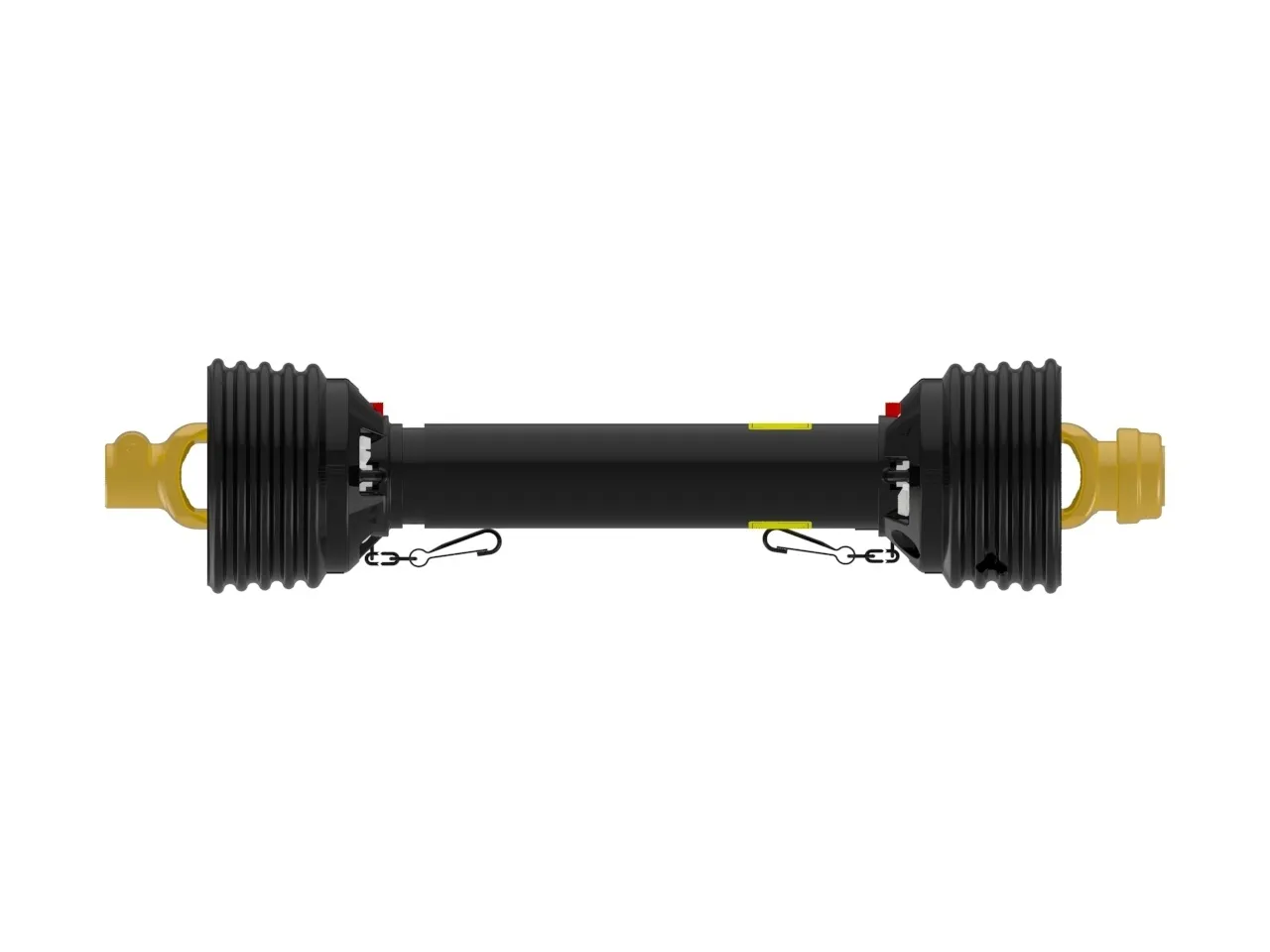
The EVER-POWER Solution: We engineered the Series 8 and Series 10 “Bio-Force” Drivelines. These are not standard tiller shafts. They feature Ventilated Friction Clutches capable of slipping under extreme load without burning out, protecting the briquetter’s main crank and the tractor’s PTO stub. We also utilize Splined Solid Bar Profiles for the telescoping section to handle the intense twisting forces of biomass compression.
Technical Specifications & Engineering Parameters
Processing fibrous material requires torque, not just speed. The driveline must be a “fuse” and a transmitter simultaneously. Below are the specs for our Feed & Biomass Series.
| Parameter ID | Specification Category | Technical Value / Standard |
|---|---|---|
| 01 | Series Classification | Series 8 (Shredders) / Series 10 (Briquetters) |
| 02 | Nominal Torque (540 RPM) | 1,240 Nm (S8) / 1,850 Nm (S10) |
| 03 | Nominal Torque (1000 RPM) | 980 Nm (S8) / 1,450 Nm (S10) |
| 04 | Max Shock Load Rating | 5,200 Nm (Die Blockage Limit) |
| 05 | Tractor Interface | 1-3/8″ Z6 or 1-3/4″ Z20 (High HP Stationary) |
| 06 | Implement Interface | 1-3/4″ Z6, 40mm Keyed, or Flange Mount |
| 07 | Closed Length (Lz) | 910 mm – 1,210 mm (Standard Stationary Setup) |
| 08 | Tube Profile | Involute Spline S48 or Star Profile (Heavy Wall) |
| 09 | Tube Material | 42CrMo4 Heat Treated Alloy Steel |
| 10 | Cross Kit Dimensions | 35mm x 106.5mm (S8) / 42mm x 104mm (S10) |
| 11 | Bearing Type | High-Temp Sealed Needle Roller |
| 12 | Safety Device | Ventilated Friction Clutch (FV) – Critical |
| 13 | Torque Setting | 2,000 Nm – 3,500 Nm (Adjustable) |
| 14 | Operating Angle | Max 10° (Alignment critical for stationary use) |
| 15 | Vibration Damping | Solid Profile reduces harmonic “wind-up” |
| 16 | Guard Material | Impact Resistant HDPE (Yellow/Black) |
| 17 | Guard Certification | NR-12 / ISO 5674 |
| 18 | Lubrication | Moly-Fortified High-Temp Grease |
| 19 | Surface Treatment | Zinc-Nickel Plating (Corrosion Resistance) |
| 20 | Telescoping Overlap | Min 300mm (Rigidity) |
| 21 | Clutch Reset | Automatic (Slipping Friction) |
| 22 | Weight | 45 kg – 70 kg |
| 23 | Application | Biomass Briquetter / Forage Kneader / Chipper |
| 24 | Warranty | 1 Year (Structure) / 1000 Hours |
| 25 | Origin Compatibility | JF, Nogueira, Lippel, Vermeer, Trapp |
The Physics of Processing: Crush, Cut, and Compress
The mechanical requirements of feed and biomass processing are distinct from field operations. It is about overcoming the structural integrity of plant fibers.
1. The “Kneading” Action (O Trabalho da “Rousiji”)
A forage kneader (often called “Rousiji” in imported contexts, or “Desintegrador” locally) doesn’t just cut; it rubs the fiber.
The Load: This creates a high-friction load that fluctuates wildly. As a bundle of tough sugarcane enters, torque spikes. As it clears, torque drops.
The Fatigue: This cyclic loading causes fatigue in standard PTO tubes.
The Solution: Splined Solid Bars. We replace hollow tubes with solid splined bars for Series 10 applications. The solid mass acts as a torsional damper and resists the fatigue cracking that occurs in welded tube seams under cyclic loading.
2. The Briquetting Wall (A Parede de Pressão)
Briquetting machines use a flywheel and a piston (or screw) to force biomass through a tapered die.
The Risk: If the biomass is too wet, it becomes incompressible (hydro-lock). The piston hits a “wall.” The flywheel inertia plus the tractor torque create a destructive force.
The Defense: The High-Performance Friction Clutch. A shear bolt is insufficient because the load is pulsing (piston strokes). A shear bolt would fatigue and break constantly. A friction clutch “burps” (slips slightly) at the peak of the compression stroke if the pressure is too high, shaving off the destructive torque spike while keeping the machine running.

3. High Inertia Start-Up
Large shredders and chippers utilize heavy rotors (100kg+) to maintain momentum.
The Problem: Starting this mass puts immense strain on the tractor PTO clutch. Stopping it puts strain on the PTO brake.
The Solution: A Combo Clutch (Overrunning + Friction). The friction part allows for a soft start (slipping until the rotor matches speed), and the overrunning part allows the rotor to spin down freely when the tractor stops, protecting the transmission brake.
Operational Context: From Feed to Fuel
The equipment is found in feedlots (confinamentos) and biomass plants.
Scenario A: Silage Production (Silagem de Cana/Capim)
Context: A stationary shredder at the pit, powered by a 100HP tractor. Continuous operation for 12 hours.
Challenge: Heat. The PTO shaft joints heat up due to continuous load and minor misalignment.
Requirement: High-Temp Grease. We factory-fill our Series 8 shafts with Lithium Complex grease rated for 260°C. Standard chassis grease would liquefy and run out, leaving the needle bearings dry and leading to failure within days.
Scenario B: Biomass Briquetting (Briquetagem)
Context: Compressing sugarcane trash or sawdust into fuel logs.
Challenge: Jamming. Foreign objects (stones, metal) often enter with the biomass.
Requirement: Torque Limiter Accuracy. The clutch must be set precisely. If too loose, it slips and burns. If too tight, the machine breaks. Our clutches utilize Belleville Springs (disk springs) which maintain constant pressure more reliably than coil springs over time.

Interchangeability & Systems Integration
We support the robust machinery ecosystem of Brazil.
Fitment Guide:
EVER-POWER Series 8/10 shafts are engineered for:
- JF Máquinas™ / Nogueira™: Heavy-duty forage harvesters and stationary shredders. Direct replacement for the main drive.
- Lippel™ / Vermeer™: Biomass chippers and grinders. We stock the large 1-3/4″ Z20 splines often used on these industrial units.
- Trapp™ / Pinhalense™: Processing equipment for coffee and general agriculture.
- Custom Briquetters: Flange yokes available to bolt directly to the flywheels of custom-built presses.
*Disclaimer: OEM names are for reference only. EVER-POWER is an independent manufacturer.
Compliance with Brazilian Regulatory Standards (NR-12)
NR-12 is critical. These machines are hand-fed or loaded by conveyors where workers are present.
The “Zero-Chance” Protection
A spinning shaft in a processing shed is a magnet for loose clothing.
EVER-POWER Processing Shafts utilize:
- Stationary Guarding: The yellow guard rides on bearings and does not rotate. If a worker brushes against it, it stays still.
- Full Clutch Enclosure: The guard cone (“Bell”) is extended to cover the entire friction clutch assembly. Exposed rotating springs are a severe violation.
- Restraint Chains: Heavy-duty chains anchor the guard to the machine frame. In stationary setups, these must be checked daily.

Material Science: Durability in the Dust
Feed processing generates fine dust that is abrasive and hygroscopic.
Dust-Proof Sealing: We use Cassette Seals on the cross kits. This is a multi-lip seal with an internal grease labyrinth. It prevents fine sugarcane dust or corn flour from migrating into the needle bearings, which would turn the grease into a grinding paste.
Zinc-Nickel Plating: Equipment is often washed down or exposed to corrosive plant juices (silage acid). We plate our tubes to prevent the telescoping section from rusting solid. A seized shaft transmits axial loads that destroy gearbox bearings.
Case Study: The Feedlot in Goiânia
Client Profile: A beef feedlot in Goiânia (GO) processing 50 tons of Napier grass and sugarcane daily.
The Problem: The feedlot was breaking PTO shafts on their stationary Nogueira shredders every 2 weeks. The failure was always the yoke ears snapping. The cause was identified as “Shock Loading.” The operators were over-feeding the machine with large bundles of sugarcane, causing violent torque spikes.
The EVER-POWER Solution: We upgraded them to Series 10 Shafts with FV55 Ventilated Friction Clutches.
The Result: Shaft breakage stopped immediately. Now, when an operator overfeeds the machine, the clutch slips audibly (screeches). This serves as a training signal to the operator to slow down. The clutch absorbs the shock, saving the yoke and the tractor PTO. The feedlot estimated a saving of R$ 40,000 in parts and downtime in the first season.
Maintenance: The “Stationary” Protocol
Stationary does not mean maintenance-free.
- Grease Daily: For machines running 10 hours, grease the U-joints daily. This flushes out dust and replenishes the lubricant film.
- Clutch Maintenance: “Slip” the clutch once a month. Loosen the springs, engage PTO for 2 seconds to polish the discs, then re-tighten. This prevents the clutch plates from rusting together and becoming a solid coupling.
- Alignment Check: Ensure the tractor is aligned straight with the machine. Even a 10-degree angle in a stationary setup generates significant heat and vibration over a 10-hour shift.
Frequently Asked Questions (FAQ)
Why does my clutch smoke?
Can I use a shear bolt instead of a clutch?
How straight does the tractor need to be?
Agri-Market Trends: Biomass Energy
Brazil is expanding its use of biomass for energy (co-generation). This creates a demand for higher-capacity densification equipment. EVER-POWER is developing Liquid-Cooled Gearboxes and Torque-Monitoring Shafts that can integrate with automated feeding systems to maximize throughput while protecting the machinery in this growing sector.
 EN
EN  ES
ES  RU
RU  FR
FR  DE
DE  PT
PT  JA
JA  AR
AR  IT
IT  ZH
ZH